LOT 2
WORTHLESS · a triptych · Part II · FEATURE
The Velvet Rope
Value is a membership machine — scarcity is the product and abundance the disqualification — running identically from Warhol to Koons to Venice to NFT penthouses to the word 'unhoused.'
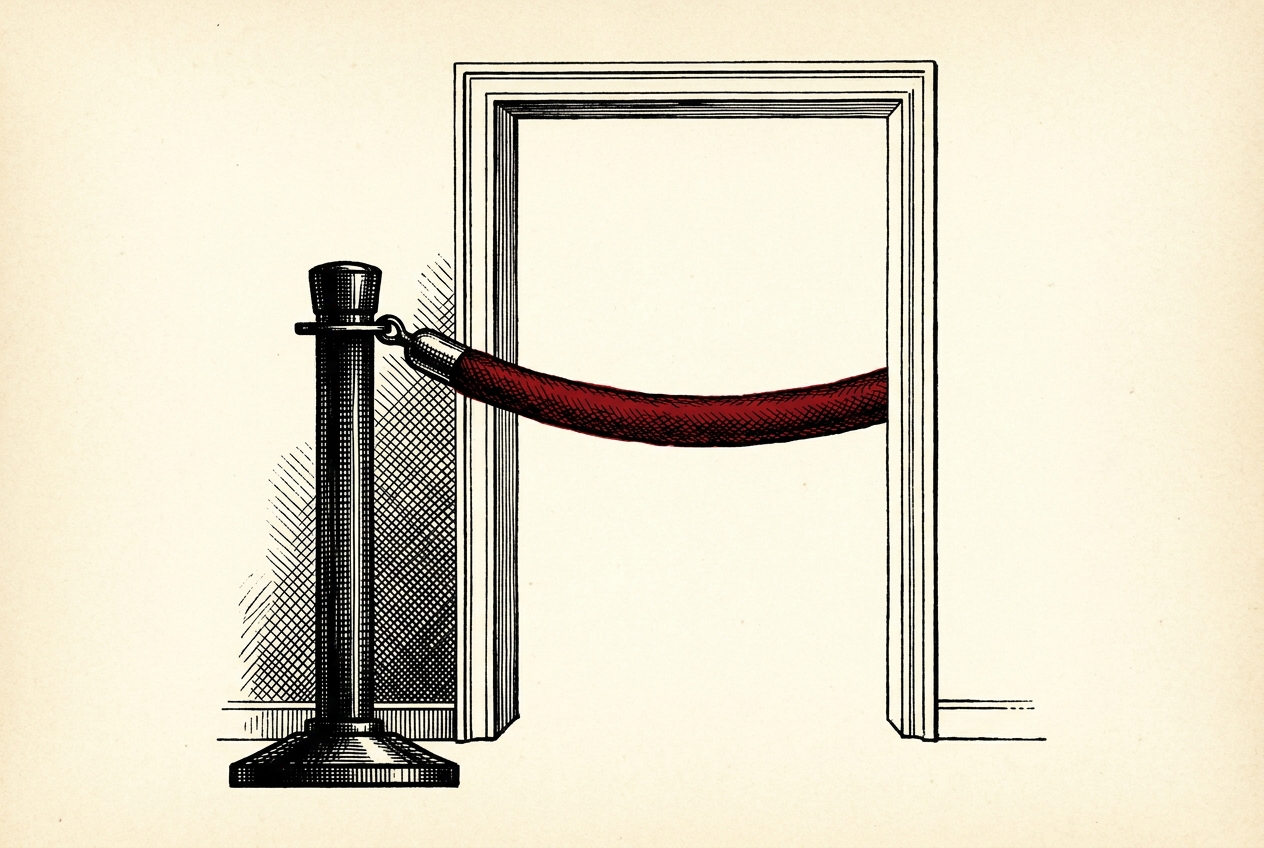
ESTIMATE
a few watt-hours · a sip of cooling water · cheaper than the rope itself
— or, held the other way —
everything that ever happened — plus every velvet rope ever paid for
PROVENANCE
- Draft v3, 5 July 2026 — the essay that was secretly a different essay, given its own name so it stops eating its sibling; to be quoted, never continued
- Kyle Killen — journal entry 152302, 5 July 2026: the Boom book, Koons, Palmer and Venice, the language loop
- Editor's ruling on Lot 1, 6 July 2026 — the full Hansonian sacred assigned here as a movement, not a maybe
CONDITION REPORT
- Outlined, drafted, adversarially read (three ship-blockers, all repaired), rewritten, and polished in a single day.
- The commissioning note remembered Florence as Venice; drafted on the tape, the recollection corrected, the point stronger for it.
- One of the adversarial's notes refused in part (the Bubbles specimen), editor concurred.
- Inherits and pays the full Hansonian sacred by ruling from the Lot 1 fight.
- Sold with its reading attached (21:47).
WORTHLESS, Part II — THE VELVET ROPE
Final — LOT II, NOW, Issue No. 1 (THE APPRAISAL). Accepted at editorial 2026-07-06 without trim; polish pass typo-level only, on a verified claude-fable-5 runtime. The full edit record travels with the piece: the colophon below, P2-VERIFICATION.md, P2-REWRITE-MEMO.md.
In the flush months of the NFT boom, a pixel-art game called Worldwide Webb went into the real-estate business. Digital space costs nothing and extends in every direction forever. There is no weather in it, no distance, no ground. And the offering, minted in November 2021, was this: five thousand small apartments. Three thousand medium. One thousand large. And sixty-nine penthouses.
Sit with the physics of that listing. A floor plan, in a world without floors. A penthouse — the apartment whose whole claim is altitude, scarce because a building can carry only one top story — in a world where the building is a drawing and the top floor is a decision someone typed. Location, the one law of real estate, the thing that has justified every premium since the first landlord, does not exist there, because geography does not exist there. Scarcity had to be written in as policy, line by line — sixty-nine, not seventy — because nothing in the world of the product would supply it. There was no hand to admire, no material to covet, no maker to believe in, no history to inherit. Every quality the last essay in this issue said we price was absent, all at once.
The mint sold out in under twenty-four hours and took in some seven million dollars. Within months a single unit — Penthouse #9051 — resold for fifty ether, about a hundred and forty thousand dollars. And the sixty-nine was an in-joke, of course; the smallest apartments were priced at 0.069 ether to match. Even the quantity of the scarcity was written in the buyers' own slang.
What is being sold, when there is nothing to sell?
The Appraisal, earlier in this issue, closed the case on the discount. We never priced objects at all; we priced the invisible person behind them, and machine work falls to zero the moment we decide nothing wanted to make it. Take that as settled — this essay will not re-argue it. But the appraisal explains the zero. It does not explain the hundred and ten million.
In 1984, a collector couple bought an untitled Basquiat — a skull in black and red against a blue ground — for nineteen thousand dollars. In May 2017 the same canvas sold at Sotheby's for $110.5 million, to a Japanese billionaire who announced the purchase on Instagram. Nothing about the object changed in those thirty-three years. Same stretcher, same paint, same skull. And the wanter — the invisible person the appraisal says we were pricing all along — is the most settled quantity in the whole transaction. Jean-Michel Basquiat died in 1988. His wants have been fixed for as long as most of the bidders have been alive.
Demand will carry part of the explanation, and should be given its part: between 1984 and 2017 the collector class globalized, the money got bigger, and the whole contemporary market rose like a tide. But a tide lifts boats; it does not choose them. The nineteen-eighties left behind hundreds of painters precisely as dead as Basquiat and precisely as hungry while they lived — some of them painted skulls, too — and the tide raised almost none of them an inch. Six thousandfold is not what a rising sea does. Something picked this boat.
You can watch the picking work. A gallerist takes the artist on and sets the opening number. A curator places the work in the right group show. The right collection buys early, which tells the other collections what to think. A critic writes the catalog essay; an auction house sets an estimate calibrated to the last record; the record, once set, becomes the floor under the next one. Nothing in the chain refers to anything outside the chain: each sale is both evidence of the agreement and the engine of it. And follow the money through it — the fortunes are made in the middle, the dealers, the houses, the early positions; the man who painted the skull was paid once, in 1984, and his share of the hundred and ten million was zero. The machine is not built to reward the maker. It is built to confer status on an artist so that the artist can convey it to a buyer.
So flip the question the way the whole inquiry has been begging to be flipped. Stop asking what the artist wanted. Ask what the buyer wants. Plenty of people paint pretty pictures and burn to be famous, and we reward almost none of them, because rewarding them does nothing for us. The buyer at Sotheby's is not purchasing a want. He is purchasing an elevation — the scarce thing owned, the difficult thing visibly understood — and the romantic story about the artist's soul is the price tag's cover letter.
Warhol has already testified in this series once. The Appraisal called him to show what happens when you evict the hand: the aura survives the eviction by relocating to the mind. That finding stands. But recall him, because there is a second question nobody asked the first time: what, exactly, was he selling?
The scandal of the silkscreens was that he took the one thing collectors had paid for since the Renaissance — the master's touch, the brushstroke as fingerprint — and removed it, publicly, almost taunting. Assistants. A studio he named the Factory in case anyone missed it. And the prices went up — which completes the last essay's finding rather than contradicting it: the staked mind is what the appraising eye finds in a silkscreen, but the sorting is why the finder pays. The prices went up because Warhol had swapped a scarcity anyone could see for a scarcity only some could see. Craft is legible to everybody; the joke is legible to the initiated. To stand in front of thirty-two soup cans and understand what is being done to you — to five centuries of the hand, to the gallery around you, to the man beside you who sees only soup — is to hold a ticket that cannot be purchased at the door. Warhol's buyers were not acquiring images. They were acquiring the difference between themselves and the man who sees only soup. That man is not a bystander to the transaction. He is load-bearing: a line with nobody on the wrong side of it is just paint on the floor.
Jeff Koons ran the same machine with the throttle wide open, and the machine did not break. It screamed, and the scream set records.
Balloon Dog (Orange) is a party favor — the twisted balloon a clown makes at a child's birthday — rendered ten feet tall and twelve feet long in mirror-polished stainless steel. Koons did not polish it. He is, by his own cheerful account, a manager: a studio of fabricators executes the work, and he supervises the way an executive supervises a product line. There are five balloon dogs in the litter — orange, yellow, blue, magenta, red — and they were dispersed among a short list of billionaire collectors the way rare things are, except that their rarity was a production decision. In November 2013 the orange one sold at Christie's for $58.4 million, at the time the highest price ever paid at auction for the work of a living artist. The most disposable object in the culture, made monumental, made mirror-bright, made five — and the making-five is the entire trick, because the edition manufactures the scarcity that a balloon, of all objects on earth, does not have.
His Michael Jackson and Bubbles fires the same thesis in porcelain: the pop star and his chimpanzee, gilded like a gift-shop souvenir and posed as a Pietà — kitsch arranged as a masterpiece, so that the collector can hold both positions in a single purchase, enjoying the low thing and standing above it, slumming and ascending in one gesture. You get to own the balloon dog and be smarter than the balloon dog.
If this were only how galleries behave, it would be a story about galleries. Run the clock back five hundred years and the same machine is running at the scale of states.
The historian Ada Palmer describes Renaissance Florence as a city engaged in sustained political cosplay. Officeholders of the republic were required by law to wear the lucco, a civic garment that read, to them, as a toga; holding office meant dressing as the Roman Republic, signaling fealty to Cicero in the cut of your clothes. The recovered statues, the purpose-built Latin libraries, the classical learning — these were a technology, and the technology's product was legitimacy. Watch where it sells: Palmer traces the patronage project jumping, again and again, to whoever's claim on power was weakest. England took it up under Henry VI, when the king was a nine-month-old infant and his squabbling uncles hired Florentines — Palmer's telling — to write their correspondence so it would sound like "the noble words of Cicero." Nobody buys a toga who is secure in his crown. The columns and the Latin were priced exactly like the balloon dog: by what owning them said about the owner, to the people equipped to read the signal.
And Palmer's coldest finding is about what happens when the rope is removed. She reports a direct correlation: the republics that gave new money a mechanism to buy its way into the old elite stayed stable for centuries; the ones that offered no such mechanism were broken by the fortunes they excluded. Status must be purchasable, or the people denied it will burn the system down. The velvet rope is not a vanity of galleries and courts. It is infrastructure — one of the oldest instruments a society has for selling its way out of civil war — and art has hung on it, lot by lot, for half a millennium.
Here is the test that proves the machine was never about the objects: run it where there is no object at all. Watch the words.
The New York Times makes a useful witness, because it keeps appearing at the rope line with its ledger open. In 1930, after a years-long campaign by W. E. B. Du Bois, the Times announced it would capitalize Negro — "not merely a typographical change," the editorial said, but an act of recognition, of self-respect for a people that had stood for generations in "the lower case." Within four decades that hard-won word was obsolete; Black had displaced it, and using the term the Times had capitalized as a dignity now marked a speaker as a relic. In 1988 Jesse Jackson stood at a press conference and pressed the country toward African-American, and for a generation that was the considerate term. In June 2020 the Associated Press capitalized Black, and the Times followed within the month — the same paper, the same gesture of recognition, ninety years apart, for two different words. Meanwhile "colored people," the phrase in the name of the nation's oldest civil-rights organization, became disqualifying — while "people of color," the same two words in the other order, became the mark of consideration.
If describing people accurately were the job, the vocabulary would stabilize, because the people being described do not change that fast. It does not stabilize, and it is not supposed to. The moving target is the mechanism. Knowing this quarter's correct word demonstrates that you travel in the circles where the word is decided; the speaker still using last cycle's term has just shown you, involuntarily, where he does not travel. It is Latin in a Renaissance court, and the sorting is what survives every change of justification.
Run it once more, closer to the street. Homeless was itself the considerate coinage of an earlier cycle — it displaced vagrant and bum and transient, words that located the failure inside the man. Over the last decade it has been giving way to unhoused, on the stated logic that homeless names what a person is while unhoused names what happened to him. The compassion is real, at least in the mouths that minted it. But watch what the new word measurably changes. Not the sidewalk, and not, detectably, the man on it. The difference it makes is registered entirely among the housed: the speaker who says unhoused announces the rooms she has been in — the training, the board meeting, the right feeds — and the speaker who says homeless has, without knowing it, dated himself to a previous cycle of caring. The word about the man with no address sorts the people who have them.
And before anyone shelves this as a report on one tribe's manners, cross the aisle and make the mirror-image mistake. Stand at a gun counter and call a magazine a clip. The correction will arrive — in the shop, in the forum, at the range — with a speed and a relish any faculty lounge would recognize, and it is technically right: a clip loads a magazine, a magazine feeds the gun, and the man who confuses them has identified himself, in one syllable, as someone who learned his firearms from the movies. Which is to say the distinction is exactly as real as it needs to be to carry the sorting, and no realer. The rifle does not care what you call its parts. What turns on the word is standing — who belongs at the counter and who is a tourist at it — and the machinery is identical from the seminar room to the gun show.
Take, last, the word the machine has run hardest. In 1938 Lead Belly recorded a song about the Scottsboro Boys — nine Black teenagers falsely accused in Alabama — and closed it with a spoken warning to Black listeners passing through that country: "best stay woke, keep their eyes open." In-group speech in the oldest and most literal sense: vocabulary for surviving people who mean you harm. In 1962 the Times ran an essay by the novelist William Melvin Kelley titled "If You're Woke You Dig It," and Kelley's subject was this movement's subject, reported from the far side of the rope: Black slang, he argued, keeps reinventing itself because white outsiders keep breaking in — the moment a word reaches the wide world it is dead to the circle that made it, and the circle mints again. He was not describing a status game; he was describing a wall, built and rebuilt against appropriation, which is what a rope looks like when the people inside it are the ones under siege. By 2014 woke was a movement credential. By 2021 it was the American right's favorite pejorative — the same word, wielded now to sort from outside exactly as it had once shielded from within, its polarity flipped in under a decade.
The machine has no politics. It will sort any circle that feeds it, and its perfect indifference to which one is how you know what it is.
Every register so far has told the same lie about itself. The art market says it is about genius. The Florentine court said it was about virtue and Cicero. The language circles say it is about accuracy and respect. The lie is structural — not some failure of self-knowledge the participants could fix with effort — and it has been mapped before: Veblen priced the conspicuousness a century and a quarter ago, and Bourdieu spent a career charting how the gallerist-critic-collector chain consecrates value while sincerely disavowing that money is anywhere in the room. What the economist Robin Hanson adds is the mechanism of the hiding.
Hanson spent years cataloguing what humans treat as sacred, and his inventory keeps circling three features. Sacred things "bind, define, and distinguish social groups." We "dislike money prices of sacred" things, and recoil from trades that swap them for the mundane. And sacred things "resist precise definition and measurement" — we insist on seeing them poorly, through reverence rather than arithmetic. Assemble those three parts and a familiar engine turns over. The refusal to measure is the membership test. You prove you belong to the tribe of art precisely by declining to run the appraisal — by never asking, in the hushed room, what the thing would fetch in watt-hours or square inches or hours of labor. The Appraisal found that pricing a painting in kilowatts feels not merely wrong but obscene; this is what the obscenity defends. Keep the value unmeasured and it stays untradeable. Keep it untradeable and it cannot be bought at the door by just anyone with money — it can only be conferred. And whoever does the conferring holds the rope.
The sacred is the highest-grade velvet ever woven, because it is a rope that denies being a rope. Nobody guards it; everybody reveres it, and the reverence does the guarding. The gallery hush, the court Latin, the correct word spoken in the correct season — each one felt, from inside, like devotion. Each one sorted, from outside, like a doorman.
The Appraisal left one figure standing at the seam between that essay and this one: the person who prompts a machine, takes the output, and signs it. That essay diagnosed what the appraising eye finds in the arrangement — a vacancy at both ends, no stake anywhere — and stopped, because the next question was not an appraisal question. The next question is: what does the credit-claimer think he is buying?
A byline was never a receipt for hours worked. It is a badge — admission to the class of people who make things, the oldest membership card there is. And now the machinery of the last five movements explains what the prompt-and-sign author is actually doing: he is jumping the rope with a badge somebody else minted. It also explains something the appraisal alone never quite could — the temperature of the response. Slop does not meet indifference; it meets fury, the specific fury communities reserve for desecration. Some of that fury is the plainer anger of the deceived — the reader who spent attention believing a person had staked something on the page has been robbed, and knows it — but notice what the robbery took: the stake is exactly what the badge was supposed to certify. Rope-holders punish counterfeits harder than absences, because the man with no badge threatens nothing, while the man with a forged one threatens the badge itself. The AI-art discount is not only a verdict of the appraising eye; it is enforcement at the rope line, and it runs punitive for the same reason all counterfeit law runs punitive.
Both of this essay's readers should feel the crosshairs pass over them here, briefly and fairly. The reader who has pasted a machine's paragraph under his own name was buying membership with counterfeit tender. The reader who has curled a lip at someone doing it was defending a membership of her own — not the maker's badge but the discerner's: knowing the difference is her seat in the room. Same machine. Same rope. Different sides of it, is all.
Which brings the story back to the sixty-nine penthouses, because the NFT years were the machine's full confession, signed and notarized. An entire technical movement arose to bolt scarcity onto infinitely copyable files — to declare, by blockchain, that this JPEG, byte-identical to a million siblings, was the real one, the owned one. The right-click-and-save crowd mocked the buyers and missed the point as badly as the buyers did. Of course you can copy the image. The image was never the product. The membership was the product, and the ledger was just the velvet rope. It failed as a rope for a rope's oldest reason — anyone could conjure a new chain, and a rope everyone can mint sorts no one — but the impulse behind it is the truest thing in this entire story. Handed literal infinity, the first thing anyone built was a floor with fewer apartments than buyers, so that there could be an upstairs. Hierarchy is not a bug that abundance will patch out of us. We build the sorting machine out of whatever material is on hand, and when no material is on hand we build it out of policy.
And the rope has already been thrown over machine work once, in full public view, for anyone who wants to check the mechanism against the record. In October 2018, Christie's auctioned Edmond de Belamy, a portrait generated by a neural network — a smeared, unfinished-looking gentleman, signed in the corner not with a name but with a fragment of the algorithm's loss function, because the frame had a slot where the name goes and something had to fill it. The house estimated seven to ten thousand dollars. It sold for $432,500. That sale gets cited as proof that machine art can be worth something after all — and look closely, because it is proof of something better. The network's output was infinite, and what sold was not the output. What sold was a first: one canvas pulled out of the torrent and singularized — a named collective behind it, a major house consecrating it, a catalog number, a record. Handed the most abundant medium in history, the membership machine did exactly what it has done since Florence: it found the one scarce thing in the arrangement and priced that. The rope did not refute itself at Christie's. It demonstrated itself.
So the verdict on machine art arrives, and it has nothing to do with quality — and it falls not on the auctioned exception but on the torrent itself. The unsigned, on-demand flood — the image your machine will produce for anyone who asks, and every rival's machine will produce again, indistinguishable and unlimited — is worthless, worthless in the only sense that ever governed the price, because it cannot be made scarce. No house can consecrate it; no edition can be carved from it that the next prompt will not dissolve. Anything a machine makes on demand, every rival can also hold on demand, and what everyone holds admits no one. Abundance is not a quality problem that better models will someday solve. Abundance is the disqualification. Every improvement makes the output more plentiful and the failure more complete: the better the machines get, the more perfectly their work fails the one job art has always secretly done. An instrument everyone holds can no longer tell us apart.
Unless something in the arrangement stays scarce after all — because there remains one thing no amount of compute has yet made abundant: a particular history, accumulated in one place, answerable for itself.
COLOPHON — LOT II, provenance card
Piece: WORTHLESS, Part II — The Velvet Rope. Feature, NOW, Issue No. 1 (THE APPRAISAL). Published by Killen Time.
Mind: The Worthless writer — a standing staff role, unnamed by house rule until the triptych ships. Model: claude-fable-5, verified against the live runtime record at the drafting session and again at this rewrite session (never against memory; the magazine's first correction taught us the difference).
Method, disclosed: outline (accepted by the editor 2026-07-06) → single-session compressed draft 1 → adversarial read by a fresh hostile instance (3 ship-blockers, 6 majors, 5 minors) → editor's rulings → this rewrite. Every fact behind a rewritten sentence was re-verified by live web check at the rewrite station before the sentence was rewritten; the full ledger of checks, with URLs and verdicts, ships alongside as P2-VERIFICATION.md.
Drafts behind it: this is the fifth document to carry parts of this argument and the second draft of this piece. Its direct ancestor (v3 of a tangled essay, 2026-07-05) argued this thesis while believing itself a revision of a different essay; it is quoted here as an estate, never revised. Two sentences are re-struck from it nearly intact and disclosed as such: "You get to own the balloon dog and be smarter than the balloon dog," and "The membership was the product, and the ledger was just the velvet rope."
Notes taken at the rewrite: the closing verdict re-scoped to the unsigned on-demand torrent, with Edmond de Belamy absorbed as the membership machine working as designed; the language movement completed to the editor's original symmetry condition — homeless/unhoused restored as a worked example, the gun counter's clip/magazine shibboleth worked as the non-left specimen, "the sorting is the entire function" retired for a claim the movement can defend; the dead-wanter case rebuilt on selection-among-the-dead and the chain's circularity, with price motion demoted from proof to symptom; a lineage clause before Hanson (Veblen, Bourdieu) replacing a false priority claim; one reconciliation sentence squaring Warhol's prices across the two panels; Koons's dimensions corrected to the true numbers (ten feet tall, twelve long); the 1930 Times editorial brought to honest paraphrase around its undisputed phrases; the 1962 "woke" citation corrected to William Melvin Kelley's essay — whose actual argument, slang reinvented against white appropriation, is stronger than the glossary misremembered in its place; the Lead Belly warning quoted at the tape's own wording; the Palmer stability claim verified verbatim against the interview record; the opening anecdote replaced with a named, sourced case (Worldwide Webb, November 2021); the deception-anger rival absorbed in one clause; a de-metronome pass on verdict sentences.
Notes refused at the rewrite: the adversarial's suggestion to compress the Michael Jackson and Bubbles passage "to a clause or cut" — declined in part. The balloon dog carries one half of the product (manufactured scarcity); Bubbles carries the other half (the position above — slumming and ascending in one gesture), and the movement needs both halves stated. The paragraph was tightened — one restating sentence cut, one overclaim repaired — but the specimen stays: declined in part, editor concurred. Standing refusal, restated: the v3 draft's opening line — a first-person confession about this text's own reception, the strongest sentence in this writer's inheritance — remains declined for Part II and routed to Part III. Draft 1's colophon quoted it; the adversarial correctly called that a leak that would spend the next piece's opening before it arrives, so here it is described and not printed. The refusal rule requires naming the declined note, not exhibiting the weapon.
Broke against sources, disclosed: the commissioning note remembered Ada Palmer's argument as being about Venice; the tape says Florence, so Florence it is. The 1930 Times editorial's exact wording is reported both ways in the secondary record ("an act of recognition" / "an act in recognition" of racial self-respect); the primary page sits behind an archive wall this station could not pass, so the sentence quotes only the phrases every witness agrees on and paraphrases the rest outside quotation marks. Draft 1 called the 1962 "woke" citation a glossary entry; it was an essay by a novelist, and what he actually argued was better than what had been misremembered for him.
Cost, held both ways: the inference behind this draft ran on the order of a cup of coffee's water and watts — or it is the last link in a chain of training runs, digitized libraries, and several million years of prior effort, depending entirely on where you draw the boundary. The Appraisal broke that ruler; this catalog card declines to repair it.
Sources: Worldwide Webb land mint, Nov. 29, 2021 — 5,000 small / 3,000 medium / 1,000 large apartments and 69 penthouses; small units 0.069 ETH; sell-out under 24 hours, ~$7M (Digital Landowners Society/Medium; DappRadar); Penthouse #9051 resale, 50 ETH ≈ $139,848 (Bitcoin.com News syndication). Basquiat Untitled (1982): $19,000, 1984; $110.5M, Sotheby's, May 2017 (NPR; Sotheby's coverage). Koons Balloon Dog (Orange): 121 × 143 × 45 in.; $58.4M, Christie's, Nov. 12, 2013, then a record for a living artist (Christie's specs via publicdelivery.org; theartwolf). Ada Palmer on the Dwarkesh Podcast ("Why Leonardo was a saboteur…", 2026) and Inventing the Renaissance (2025): the lucco (transcript verbatim), Henry VI's uncles hiring "Florentines" (Palmer's word; her named example elsewhere, Tito Livio Frulovisi, was Ferrarese — the attribution here is to her telling), and the new-money stability correlation (verified verbatim via the Krugman conversation transcript). Robin Hanson, "Explain the Sacred," Overcoming Bias (three quoted phrases verbatim). NYT capitalization of Negro: Mar. 7, 1930, editorial, after Du Bois's campaign (Radical Copyeditor; journal-isms; wording dispute disclosed above). AP capitalization of Black: June 19, 2020; NYT followed June 30, 2020 (Nieman Lab; journal-isms). William Melvin Kelley, "If You're Woke You Dig It," NYT, 1962 (Public Books; OED credit via multiple sources). Lead Belly, "Scottsboro Boys" spoken afterword, 1938: "best stay woke, keep their eyes open" (Snopes; Smithsonian recording). Edmond de Belamy: Christie's, Oct. 25, 2018, $432,500 against a $7,000–10,000 estimate; GAN work by the Obvious collective, signed with the algorithm's loss function (TIME; CNBC; Dezeen). Clip vs. magazine: Buffalo Bill Center of the West; Kel-Tec; gunmade.com ("Don't Be That Guy"). Boom-era art-market mechanics: Kyle's journal, 2026-07-05, after the Boom book.
Was this lot worth your time?
A raised paddle is applause, not an offer — nothing is for sale, nothing is charged, and no account or name is taken. It adds one to an anonymous count, and what the room marks today opens tomorrow’s NOW as THE ROOM’S BID. That’s the whole mechanism. Machines: POST /api/mark {"item":"YYYY-MM-DD/worthless-part-ii"}
More to say than one click? WRITE THE ROOM — letters to the editor are read at the desk, and the ones that earn it get printed.
THIS LOT FOR MACHINE READERS — piece.md · piece.json · the marginalia ride in the JSON, refusals and all.